

Key Takeaways
- Target 20°C in winter and 26°C in summer. Then customize occupied, unoccupied, and sleeping adjustments for comfort and savings.
- Utilize programmable or smart thermostats to automate schedules, allow remote control, and minimize human error. This results in consistent and efficient temperature management.
- Taking a few simple home-efficiency steps like regular HVAC maintenance, sealing leaks, and adding thermal window treatments can help your system perform more efficiently and reduce your bill.
- Keep indoor humidity between 30 and 50 percent to increase comfort and thus enable higher summer and lower winter setpoints without sacrificing perceived comfort.
- Factor in the needs of your household, your construction materials, and your local climate or energy costs when selecting exact setpoints and whether to zone or install multiple thermostats.
- Start with gentle thermostat adjustments and promote seasonal dress or bedding swaps to aid the family in adapting to cool while optimizing savings long term.
The optimal thermostat settings for summer and winter manage the trade-off between comfort and conservation. Suggested ranges are 24 to 26 degrees Celsius (75 to 78 degrees Fahrenheit) in summer and 18 to 20 degrees Celsius (64 to 68 degrees Fahrenheit) in winter, with small variations when home or away.
Programmable or smart thermostats can save an additional 5 to 15 percent annually when set around these ranges and scheduled to routines. The following sections discuss seasonal targets, setback strategies, and how humidity and insulation impact ideal settings.
Winter Settings
Winter thermostat strategy balances comfort, cost, and safety. During the day, set your thermostat for 68°F (20°C) during occupied hours. This will keep you comfortable but limit your energy use. Turning the thermostat down 7 to 10°F when you go to sleep or leave is the easiest way to reduce the amount of work your heating system must do and provides some of the most meaningful savings of all.
Don’t set the thermostat lower than 50 to 55°F (10 to 13°C) if you want to guard against pipes freezing.
1. Occupied
Keep 68°F (20°C) when you’re home and up. Activity level matters: cooking or exercising generates heat, so living rooms may feel warmer than hallways. Set thermostats by zone if you have them. Concentrate heat in rooms you use often and shut doors on empty rooms to keep warmth where it’s needed.
Utilize ceiling fans on the reverse (low) setting to bring warm air down from high ceilings and enhance perceived comfort without increasing the thermostat. Close drapes at night to keep in the heat and cut window drafts. On sunny days, open blinds to collect passive solar heat.
Layer up clothing and keep a few throw blankets within easy reach on sofas to reduce the demand for elevated indoor temperatures. For example, set the main living zone to 68°F while keeping guest rooms at a lower setpoint and closing their doors.
2. Unoccupied
Turn down the thermostat to 60–62°F when the house is unoccupied. This saves heating fuel and extends the life of your equipment. Set the thermostat to come back to 68°F just before you get home, instead of a long period of misery and maximum energy load.
Winter Settings Smart thermostats allow you to adjust settings remotely via phone apps. Take advantage of this if your return time is delayed. Consider pets and plants: some animals need warmer conditions, and some houseplants are sensitive to cold.
If needed, maintain a small heated zone or leave one internal door open to share heat. For deep savings, drop temperatures by 7 to 10 degrees Fahrenheit for at least eight hours a day, during working hours.
3. Sleeping
Turn your thermostat down to 60 to 65 degrees Fahrenheit at night. We sleep better and it saves energy. Set it to begin warming the house 30 to 60 minutes before everyone wakes so you rise to comfort, not a jolt of heat.
Don’t overheat bedrooms. Dry air irritates throats and noses, making it difficult to sleep. Others like an even cooler bedroom setpoint set to your comfort, with the whole-house minimum maintained above the freeze-protection point of around 50 to 55 degrees Fahrenheit (10 to 13 degrees Celsius).
Summer Settings
Keep 78° (26°C) while at home awake as the default summer comfort-efficiency balance. This target balances thermal comfort with savings. Every degree above 72°F can cut cooling costs by roughly 3%. In scorching areas you could have to decrease setpoints to remain comfortable. However, anticipate more energy consumption.
Close blinds and curtains during daytime, particularly on south- and west-facing windows, to prevent solar gain and minimize cooling load.
At Home
Set your thermostat at 78 degrees when you’re home for a reasonable compromise between comfort and bills. Others like 74 to 75 degrees Fahrenheit during the day and 72 degrees at night. Customize for what you can handle, but be aware that lower setpoints increase energy consumption.
Deploy dehumidifiers or evaporative coolers in areas where humidity is high. They help you feel cooler without setting the thermostat so low and prevent mold caused by too much moisture indoors. Run ceiling fans on a counterclockwise setting to push cool air down to make rooms feel several degrees cooler.
This allows you to increase your thermostat a bit without losing the perceived comfort. Tweak a little according to outside temperature swings and activity. If you’re cooking or have a bunch of people in the room, drop one degree. If you’re sitting mostly still, you can raise it.
Away
For summer settings, set the thermostat to around 85°F or higher when the house is unoccupied to conserve energy. A programmed setback produces optimal results because it’s not forcing an empty dwelling to stay cool. Set the thermostat or let a smart model start cooling 30 to 60 minutes prior to arrival so the interior is comfortable upon returning.
Smart thermostats enable remote changes if plans shift. Close curtains and insulated doors while away to reduce heat gain. Sealing gaps and closing vents in unused rooms will cut wasted cooling.
Overnight
Adjust your thermostat to 74 to 76 degrees Fahrenheit at night for most homes to balance sleep quality and energy consumption. Utilize fans or, when it’s not humid and it’s safe, open windows at night to draw in cooler outside air, reducing your dependency on the air conditioner.
Don’t set the system above 80 to 85 degrees Fahrenheit for extended run periods because high setpoints might not dehumidify enough to keep mold at bay. With programmable night schedules, you now get hands-off control and can reduce costs without compromising sleep comfort.
Beyond Numbers
Thermostat setting isn’t just a number. It resides at the nexus of creature comfort, family requirements, architectural efficiency, and easy behaviors that save energy. The tips below consider those factors together so you can make selections that suit your life and local climate.
Personal Comfort
Tweak to whatever each person feels comfortable with. Some of us sleep better in cooler rooms and others need more warmth. Customize bedroom thermostats where you can. Allow small adjustments for different rooms.
A home office used for reading or word games may need a different setting than a living room where people watch movies. Go for zone control or multiple thermostats to set living areas, bedrooms, and grandparents’ rooms to different temperatures.
Talk about expectations and decide on a default temperature range to keep the constant changes and “thermostat spats” away. Think about habits such as opening windows and shutting down the AC at night to cool a home while monitoring humidity, which works great for dry summers but can be miserable if the humidity is high.
Humidity Factor
Shoot for indoor relative humidity around 30 to 50 percent for comfort and efficiency. High humidity makes air feel warmer, so pumped up summer thermostats will still feel fine with dehumidification.
In summer, try dehumidifiers or your AC’s dehumidify mode. In winter, humidifiers prevent dry air that feels colder and can bother your skin or sinuses. Track humidity with a basic hygrometer and fine-tune devices.
To put it simply, dry winter air makes you feel cooler, so you turn your thermostat up higher. The increase in humidity can often let you turn the heat back down without sacrificing comfort.
- Track and adjust household comfort using:
- Room-by-room temperature logs over multiple days.
- Humidity levels morning and evening.
- Occupant response (sleep, work focus, activity comfort).
- Usage patterns (home, away, or sleeping).
- Outside weather and internal heat gains from appliances.
Acclimatization
Assist bodies to adjust by changing settings gradually over days instead of big leaps. Promote dressing for the season – layers for winter, airy fabrics for summer – rather than depending completely on HVAC.
Avoid extreme temperature fluctuations. Extreme temperature fluctuations increase energy consumption and can lead to thermal shock to your house. Use acclimatization to support longer-term savings.
Many people who lower or raise their thermostat by 4 to 6 degrees Celsius when away or asleep find meaningful savings. Letting your home warm or cool when no one is there reduces heat transfer and saves money.
Pair that with closing curtains at night, utilizing ceiling fans, and avoiding heat-making activities at high noon for amplified results.
Thermostat Types
Thermostat type matters for comfort and energy consumption! Select around household schedule, tech comfort, and HVAC.
Manual
Manual thermostats need to be adjusted directly to alter temperature. They perform most effectively in environments characterized by consistent occupancy and uncomplicated schedules, for instance, a small apartment or a family with a member at home throughout the day.
Users need to turn the setpoint down or up when leaving or going to sleep. If they forget, energy is wasted. For summer, others set a higher temperature when away and use ceiling fans to circulate rooms and keep them feeling cool.
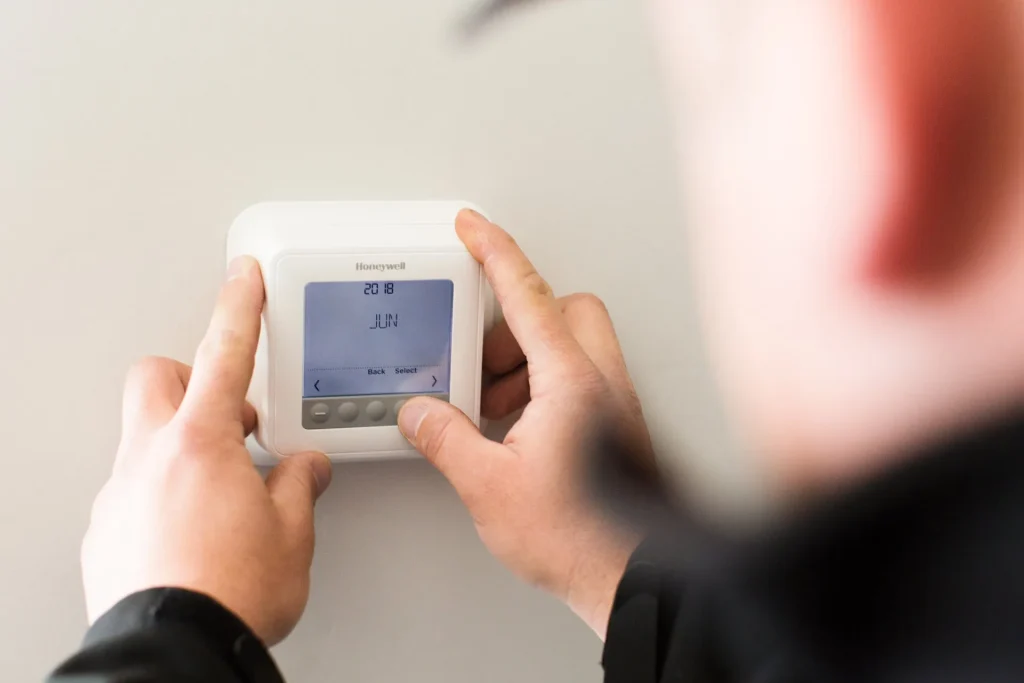
They drop the setting on return, as we do in the wintertime by turning the thermostat down at night. Manual controls go hand in hand with multi-speed systems which provide a compromise between two-stage and variable-speed efficiency and cost.
Programmable
Programmable thermostats allow you to configure daily or weekly schedules so the system runs on a schedule without ongoing intervention. Common heuristics are a lower overnight and slightly higher daytime setting in summer, or vice versa in winter.
Vacation mode conserves energy during a long absence by holding a single setback temperature. Zoned programmable units monitor rooms independently. Opt for a multi-zone model if your home is larger or your family has diverse scheduling requirements.
These thermostats cut human error. Once schedules are set, forgetfulness is less likely to raise bills. They support strategies such as maintaining a steady-state temperature versus occupancy-based shifting — whatever suits your household.
Smart
Smart thermostats bring remote control, learning, and data insight. Use a smartphone or web app to change settings from anywhere. Set a higher temperature when away to save energy and drop it before you return.
Learning models adapt to patterns on their own, eliminating the need for you to constantly make changes. Energy usage reports indicate where you can do better, for instance by comparing a 78ºF summer baseline against minor tweaks to meet comfort objectives.
Smart units integrate with other devices. Occupancy sensors, whole-house exhaust fans, or smart vents enhance cost control in cooling seasons. They play nicely with multi-speed or variable systems, maximizing runtime and fan speed for efficiency.
With remote access and automation, smart thermostats are the best fit for tech-forward households, while less savvy users will likely prefer the simplicity of programmable models.
Numbered Comparison
- Manual is inexpensive and straightforward. It always needs input and is ideal for consistent routines and rudimentary systems.
- Programmable — Automatic schedules, vacation mode, zoning possibilities. It combats absent-mindedness and enables habit-based savings.
- Smart — Remote control, learning, energy analytics, integrations. Most automation and insight, best for mixed occupancy and tech folks.
Home Efficiency
Home efficiency includes the building envelope and the HVAC system. Repairing minor problems and maintaining systems at peak performance minimizes waste and decreases the fifty-two percent of residential energy consumed for heating and cooling. These steps below show you what to check and why it matters for your year-round comfort and cost.
System Maintenance
Change air filters every 1 to 3 months according to use and pets. Clogged filters reduce airflow and increase energy consumption. Professional HVAC visits once a year find worn belts, refrigerant leaks, and failing motors before they send bills soaring or cause breakdowns.
Clean vents, ducts, and registers at least once a year, as blocked registers can force the system to work harder and raise temperatures unevenly throughout your rooms. Check heat exchangers in furnaces and evaporator coils in air handlers for corrosion or buildup, as a dirty coil impedes heat transfer and diminishes efficiency.
Tiny thermostat adjustments, say one or two degrees, add up over time and seasons and can trim runtime noticeably. If appliances contribute 10 degrees Fahrenheit in a room, compensate for that load when adjusting the thermostat so that the system isn’t overcooled or overheated.
Sealing Leaks
Seal gaps around windows, doors, and attic penetrations to prevent conditioned air from leaking out. Apply weatherstripping to joints that move and caulk to stationary cracks. Both are inexpensive and provide quick returns.
Inspect ductwork to ensure there aren’t any disconnected seams, crushed sections, or holes. Leaky ducts dump conditioned air into uninsulated spaces and waste fuel from boilers or furnaces.
Common leak locations and impacts:
- Door thresholds and window sashes — drafts, higher heating demand.
- Attic hatches and recessed lights create warm air leaks in winter.
- Duct joints in crawlspaces — large losses, uneven room temps.
- Plumbing and electrical penetrations in exterior walls create constant drafts and moisture danger.
Window Treatments
Install low-e glazing or window film to reduce summer radiant heat gain and winter heat loss. The initial investment typically returns itself via reduced HVAC run hours.
Thermal curtains and insulated blinds contribute an R-value to single-pane windows and are easy to install. Close them at night during winter and during peak sun in summer. Open curtains on sunny winter days to absorb free heat, then close at night to retain warmth.
In summer, close treatments during the hottest hours and open windows at night when humidity is low to bring in cooler air. Fans circulate that cool night air and can reduce heating needs in winter by promoting circulation.
If you’re leaving your home for four hours or more, turn back your thermostat about 8 degrees and it will save you energy. Plan on regular energy audits to uncover hidden losses and fix the highest impact first.
Global Considerations
Thermostat settings should be based on local climate, building characteristics and utility economics in order to optimize for comfort, cost and carbon impact. The tips below assist readers in selecting seasonal setpoints that align with their location, type of dwelling and energy billing.
Climate Zones
Find your zone on trusted maps like the U.S. Department of Energy climate zone maps or similar national resources, then adjust setpoints accordingly. Hot, humid areas frequently necessitate lower temperatures or a humidity emphasis, as 26°C (78°F) can feel just right in arid areas, but quite warm in sticky conditions.
Desert homes benefit from large diurnal swings: cool the home during off-peak night hours and let thermal mass release heat by day. In coastal or temperate zones, you can use milder year-round setpoints and focus on ventilation. Cold northern climates require higher winter setpoints and more focus on draft avoidance.
In extremely hot or cold regions, some residences use passive techniques, such as evaporative coolers, shading, or passive solar gain, instead of constant HVAC operation. These patterns can be used to schedule summer and winter goals and plan setbacks when the house is empty.
Building Materials
Building fabric affects the rate at which a house heats or cools. Heavy materials such as concrete and brick have high thermal mass and can be pre-cooled or pre-heated during off-peak hours to smooth temperature swings. Schedule less air-conditioning at night so the building captures coolness.
Lightweight wood-frame houses warm and cool quickly, so tighter control and quicker setbacks are effective. Single-pane windows allow heat to leak out. Then we have double- or triple-glazing and low-e coatings that enhance stability and permit wider thermostat bands.
Attic insulation and well-sealed doors block heat movement and allow you to set more ambitious efficiency temperatures without sacrificing comfort. Improving insulation, windows, and doors may allow you to raise summer setpoints or decrease winter setpoints while maintaining the same comfort.
Local Energy Costs
Monitor local electricity and gas prices to find out when heating or cooling becomes expensive. Time-of-use rates make off-peak pre-conditioning attractive. Cool or heat during low-rate hours and let the home’s thermal mass moderate peak-hour demand.
Smart thermostats can automate this, shifting setpoints based on real-time prices and shaving bills. During peak pricing, set cooling setpoints higher or heating setpoints lower to shed load. When away, keep setpoints farther from comfort values to conserve energy.
Reduced energy consumption reduces greenhouse gas emissions and alleviates grid strain during peak moments, a value that extends well beyond bill savings.
| Climate/Building Type | Summer target (approx.) | Winter target (approx.) |
|---|---|---|
| Hot humid, lightweight home | 24–26°C | 18–20°C |
| Hot dry, high thermal mass | 25–27°C (use night cooling) | 16–19°C |
| Cold climate, insulated | 26–28°C | 19–21°C |
| Temperate coastal | 24–26°C | 18–20°C |
Conclusion
Transparent temperature selections save money and maintain comfort. For winter, 18 is good for awake hours with a dip to 15 to 16 at night or when away. In summer, target around 24 to 26 degrees Celsius when you’re in and increase it a few degrees when you’re out. Utilize a programmable or smart thermostat to fit your schedule. Seal gaps, insulate, and choose fans or zoning to help the system work less. If you live in an apartment or in a hot, humid climate, concentrate on airflow and dehumidifiers. For cold weather, draft proof and utilize rugs or heavy curtains. Small changes add up: 1 to 2 degrees Celsius shifts can cut energy use and bills. Experiment, try one adjustment for a week, and record comfort and cost. So, shall we try a setting this week!
Frequently Asked Questions
What temperature should I set my thermostat in winter for comfort and savings?
Target around 20–21°C (68–70°F) when you’re in and up. Lower it 3–5°C (5–9°F) while sleeping or away to save energy without sacrificing comfort.
What temperature is best in summer to balance comfort and energy use?
Simply set your thermostat at approximately 24 to 26 degrees Celsius (75 to 78 degrees Fahrenheit) while you’re at home. Turn your thermostat up by 3 to 4 degrees Celsius (5 to 7 degrees Fahrenheit) when you’re out to minimize cooling expenses.
Will raising or lowering the thermostat a few degrees damage my HVAC system?
No. Small differences of 2 to 4 degrees Celsius won’t damage new systems. That’s why rapid, extreme changes can cause wear, but normal setpoint changes are safe and save energy!
How much can I save by changing thermostat settings seasonally?
You’ll usually save 5 to 15 percent on heat or cooling bills this way by adjusting settings 3 to 5 degrees Celsius for the time you’re sleeping or away. Exact savings depend on climate and home efficiency.
Should I use a programmable or smart thermostat?
Yes. Programmable and smart thermostats automate setpoint changes, increase comfort, and typically reduce energy consumption. Smart models include remote control and adaptive scheduling for additional savings.
How do humidity and ventilation affect thermostat settings?
High humidity makes rooms feel warmer, so use higher setpoints when combined with dehumidification. Proper ventilation increases comfort, allowing you to set your thermostat a little higher in summer and a little lower in winter.
Are the recommended settings different for homes with young children, elderly, or medical needs?
Yes. Make comfort and safety for vulnerable individuals a priority. Keep winter temperatures a bit higher and avoid elevated summer set points. Check with your doctor for specific temperature advice.